
Inspired by our hiking small groups at PCTC, Pastor Julie Delezenne wrote a 12-month hiking devotional to be used by small groups or individuals embarking on hikes in Northern Michigan (or similar climates!). Begin your hike by reading the devotional and closing prayer together and continue with one or more of the listed “practices” during the hike. Suggested hikes listed connect with the theme of the month (but are only suggestions!). May God bless your journey in God’s wonder-full creation.
March: Maple Trees and Maple Syrup
Suggested Hikes:
Maple Hurst Natural Area
Maple Bay Farm and Natural Area
The maple tree is a gift that keeps offering us wonder all year round: shade in the summer; brilliant reds, yellows, oranges in the fall; the magic of helicopter seeds falling in spring or fall depending on the species. And of course, maple syrup in those waning days of winter, just as we are feeling a renewed hope of spring’s arrival.
In her book, Braiding Sweet Grass, Robin Wall Kimmerer shares that the new moon of early spring- the Zisibaskwet Giizis, Maple Sugar Moon- ushers in the start of the Anishinaabe new year. “It is when the earth starts to wake up from her well-deserved rest and renews her gifts to the people” (Kimmerer, 80).
Maple syrup is the oldest agricultural product in the U.S., or rather we might say Turtle Island (the Anishinaabe name for this land), as our Anishinaabe neighbors tell us that they have been gathering the sap and boiling it down since time immemorial. Michigan is one of the top producers of this precious commodity that takes 40 gallons of sap to make one gallon of syrup.
For the sap to run in the tree there needs to be a combination of “warm” (35-42 degree) days and freezing nights. Kimmerer says that, “When hollows appear in the snow around the tree bases, I start to think it’s tapping time. The dark bark absorbs the growing heat of the sun and then radiates it back to slowly melt the snow that has lain there all winter. When those circles of bare ground appear, that’s when the first drops of sap will plop onto your head from a broken branch in the canopy” (65).
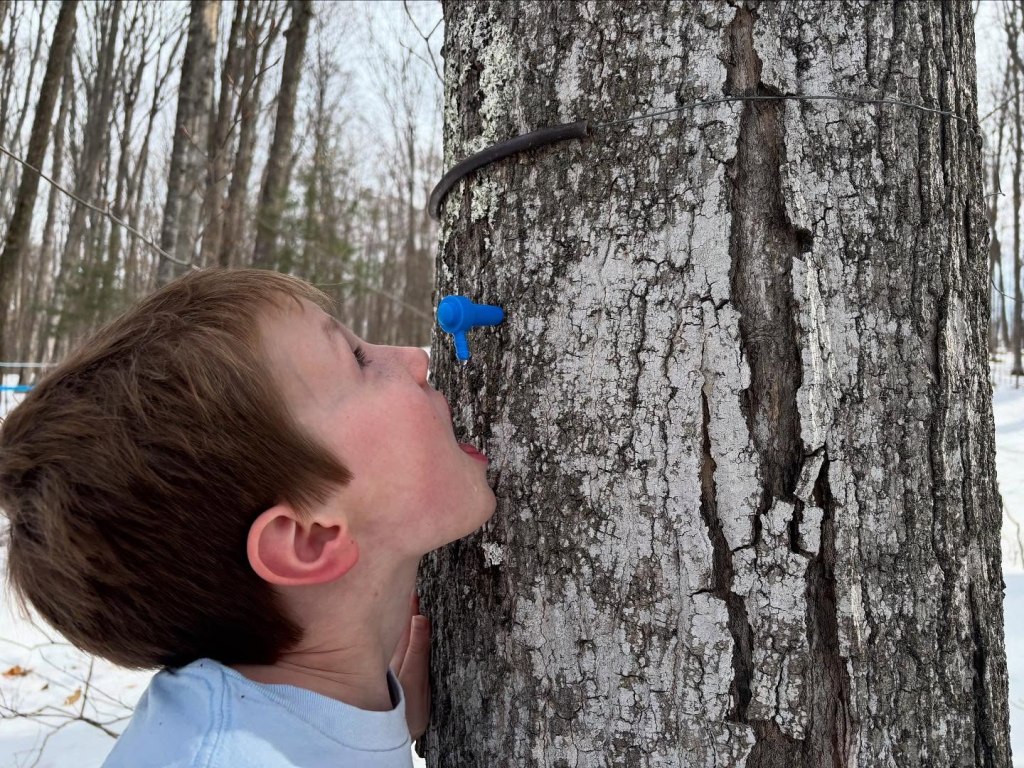
This past winter, a member of our church invited my boys and me to come out to his land where he taps trees and boils the sap traditionally over a wood burning stove. He told me he would text me when it was flowing and they were working. The text came one afternoon during the week, and I went to get my boys out of school a little early (they didn’t mind, nor did their principals!) to go and see.
Our mid-week afternoon impromptu adventure and seeing the sap flow from the tree reminded me that in life, the timing of both the “bad” things and the “good” things is not necessarily up to us.
March is often the month where the Church is journeying through the season of Lent and sometimes the month where Easter occurs. We live this season contemplating the mysteries of life and death, joy and sorrow, endings and beginnings. The bare March maple tree flowing with sap beneath its bark is a reminder that things aren’t always as they appear and the timing of new life is often beyond our keeping.
During the Hike:
- It is of course easier to spot a maple tree in the fall before the leaves fall off, but see if you can spot a maple tree on your hike! Look for the fallen leaves around the base of the tree. The bark on a maple tree can vary as the tree ages, but is often grooved or even shaggy. Check out this video if you find some fallen leaves to help identify the type of maple tree from among the most common: https://www.youtube.com/watch?v=ASZywuOCRtk
- Listen to this story of how the Anishinaabe learned to gather maple syrup and how it came to be that it is gathered only one time each year: https://www.youtube.com/watch?v=21MJnTCgMUc
- Discuss with a hiking partner or ponder alone: What has been flowing inside you lately? Joy, sadness, anger, hope, despair, longing, peace? What signs of resurrection have you seen in your life, home, community lately?
Prayer:
Creator God, you alone order the seasons. Your timing is not our timing. Help us to live into your rhythms in both patience and perseverance. Amen.
Bibliography:
Kimmerer, Robin Wall. Braiding Sweetgrass: Indigenous Wisdom, Scientific Knowledge, and the Teachings of Plants. Milkweed Editions, 2013.
 Presbyterian Church of Traverse City